

15 Steps To Take Before Retirement So You Feel Truly Ready
Some links in this post are affiliate links. As an Amazon Associate, we earn from qualifying purchases that help keep our content free.
Retirement can feel exciting and a little overwhelming at the same time. There are financial decisions to make, healthcare to sort out, practical loose ends to tie up, and a whole new daily life to think about. These 15 steps to take before retirement will help you prepare for both the practical side and the life that comes after work, so you can move into retirement feeling more confident, organized, and truly ready.
1. Picture Your Retirement Life

Before you focus on numbers, think about what you want retirement to actually look like.
Where do you want to live? How do you want to spend your mornings? Do you want to travel, volunteer, work part-time, spend more time with family, or simply enjoy a slower pace?
Try to picture a normal week, not just the big dreams.
Ask yourself:
- What would an ideal Tuesday look like?
- How much structure do I want in my days?
- Who do I want to spend more time with?
- What hobbies or interests do I want to make room for?
- Do I want to stay where I live now or make a change?
- What am I looking forward to most?
This step matters because retirement is not only about leaving work.
It is about building a new rhythm for your life.
The clearer that picture becomes, the easier it is to make practical decisions about money, housing, healthcare, travel, and how much income you may actually need.
2. Know What You Really Spend

Before you create a retirement budget, you need to know what life actually costs you now.
Look back at the last 6–12 months and include more than just your regular monthly bills.
Think about:
- housing
- groceries
- utilities
- insurance
- healthcare
- transportation
- subscriptions
- travel
- gifts
- home repairs
- hobbies
- dining out
- unexpected expenses
The goal is not to judge your spending.
It is to get an honest picture.
Retirement budgets often fail because people remember the obvious expenses but forget the irregular ones, like replacing a car, helping family, taking a vacation, or repairing the roof.
And remember: today’s prices will not stay the same forever.
Groceries, healthcare, insurance, utilities, travel, and other everyday expenses can become more expensive over time. Your retirement may last 20 or 30 years, so leave room for rising costs instead of assuming your spending will stay frozen at today’s level.
A Simple Retirement Spending Worksheet
Use your recent bank and credit card statements and fill in a rough monthly average:
| Expense | What You Spend Now | Expected in Retirement |
|---|---|---|
| Housing | $_____ | $_____ |
| Groceries | $_____ | $_____ |
| Utilities | $_____ | $_____ |
| Healthcare | $_____ | $_____ |
| Insurance | $_____ | $_____ |
| Transportation | $_____ | $_____ |
| Travel | $_____ | $_____ |
| Hobbies & entertainment | $_____ | $_____ |
| Gifts & family | $_____ | $_____ |
| Home & car repairs | $_____ | $_____ |
| Other | $_____ | $_____ |
| Total | $_____ | $_____ |
Then ask:
- Which expenses may disappear after retirement?
- Which expenses may increase?
- Will you travel more?
- Will healthcare cost more?
- Will you need to replace a car or make home repairs?
- Are you leaving room for inflation and rising prices?
- Is there enough flexibility for unexpected expenses?
Once you know what you really spend, you can build a retirement budget around your actual life, not an unrealistic number that only works on paper.
3. Create a Realistic Retirement Budget

Now that you know what you spend, turn those numbers into a retirement budget.
Keep it simple and divide your spending into three groups:
- Essentials: housing, groceries, healthcare, insurance, utilities
- Lifestyle: travel, hobbies, dining out, entertainment
- Irregular costs: home repairs, car replacement, gifts, large medical bills
Then compare your expected monthly spending with your expected retirement income.
Also build in some breathing room.
Your budget should allow for:
- rising prices
- higher healthcare costs
- unexpected repairs
- family expenses
- travel or experiences you want to enjoy
Do not create a budget that only works if everything goes perfectly.
A good retirement budget should feel realistic enough to live with for years, not restrictive enough that you abandon it after a few months.
A Simple Monthly Example
Here is what a sample retirement budget could look like:
| Monthly Expense | Example Amount |
|---|---|
| Housing | $1,500 |
| Groceries | $600 |
| Utilities | $300 |
| Healthcare & prescriptions | $550 |
| Insurance | $300 |
| Transportation | $400 |
| Dining & entertainment | $300 |
| Travel fund | $400 |
| Home & car repairs | $250 |
| Gifts & family | $150 |
| Miscellaneous | $250 |
| Total Monthly Spending | $5,000 |
If this household expects $4,200 per month from Social Security, pensions, and other guaranteed income, there is an $800 monthly gap.
That gap may need to come from retirement savings, investments, part-time income, or spending adjustments.
And this is where planning becomes useful.
Maybe housing will be lower after the mortgage is paid off. Maybe travel will be higher during the first few years. Maybe healthcare will increase later.
The goal is not to predict every dollar perfectly.
It is to understand the size of the gap between the lifestyle you want and the income you expect.
And remember: retirement spending often changes over time.
You may spend more on travel and hobbies in your first retirement years, then more on healthcare later.
Think of your budget as a flexible plan, not a fixed number you can never change.
4. Test-Drive Your Retirement Budget

Before you retire, try living on your expected retirement budget for a few months.
This is one of the easiest ways to find out whether your plan actually works in real life.
If you expect to have $5,000 a month available in retirement, try limiting your current spending to roughly that amount.
Put any extra income aside instead of spending it.
Then pay attention.
Ask yourself:
- Did the budget feel comfortable?
- Which expenses did you underestimate?
- Did you forget annual or irregular costs?
- Was there still room for fun?
- Did you constantly feel restricted?
- Could you handle an unexpected $1,000 expense?
You may discover that your budget works perfectly.
Or you might realize that travel costs more than expected, groceries have gone up, or you simply want more flexibility.
That is useful information.
Don’t Forget About Inflation
A budget that works today may not buy the same lifestyle 10 or 20 years from now.
For example, if your expenses are $5,000 per month today and prices rise by an average of 3% per year, that same lifestyle could cost about $6,700 per month in 10 years.
You do not need to predict inflation perfectly.
Just avoid building a retirement plan that assumes prices will stay the same forever.
Pay particular attention to expenses that can rise quickly, such as:
- healthcare
- insurance
- groceries
- utilities
- travel
- home maintenance
Build some flexibility into your plan so you can adjust as costs change.
It is much easier to adjust your retirement date, savings goal, or spending plan before you leave your paycheck behind.
As a bonus, the money you do not spend during your test run can go straight into your retirement savings or cash reserve.
5. Estimate Your Retirement Income

Once you know what retirement may cost, figure out where the money will come from.
Make a list of every income source you expect to have in retirement, such as:
- Social Security
- a pension
- 401(k), 403(b), or IRA withdrawals
- savings and investments
- rental income
- annuity income
- part-time work or a small business
Then estimate how much each source could provide per month after taxes.
For example:
| Retirement Income | Monthly Amount |
|---|---|
| Social Security | $2,400 |
| Spouse Social Security | $1,600 |
| Pension | $800 |
| Retirement account withdrawals | $1,000 |
| Total Monthly Income | $5,800 |
Now compare that number with the retirement budget you created earlier.
If you expect to spend $5,000 per month and have $5,800 coming in, you have some breathing room.
If you expect $5,000 in expenses but only $4,000 in income, you have a gap to solve.
That does not automatically mean you cannot retire.
It may mean you need to:
- work a little longer
- save more before retiring
- reduce certain expenses
- claim Social Security later
- use retirement savings differently
- earn some income during retirement
The important thing is to identify the gap before retirement, when you still have more options available.
And do not assume every source of income will start on your retirement date.
Social Security, pensions, and retirement-account withdrawals may all begin at different times. Map out those dates so you know how you will cover the months or years in between.
6. Review Your Social Security Options
Social Security may become one of your most important sources of retirement income, so do not automatically claim it the day you stop working.
You can generally start retirement benefits as early as age 62, but claiming before your full retirement age permanently reduces your monthly benefit. For people reaching age 62 in 2026, full retirement age is 67. Waiting beyond full retirement age can increase your monthly benefit until age 70.
Before deciding when to claim, look at:
- your expected monthly benefit at different ages
- your health and life expectancy
- whether you plan to keep working
- your spouse’s benefits
- other retirement income you can use while you wait
- how much guaranteed monthly income you want later in life
For someone born in 1960 or later, claiming at 62 can reduce the monthly benefit by as much as 30% compared with waiting until full retirement age. On the other hand, delaying beyond full retirement age earns delayed retirement credits, and those increases continue until age 70.
Check Your Own Numbers
Do not rely on a generic example.
Sign in to your my Social Security account and compare your estimated monthly benefit at different claiming ages. The Social Security Administration provides personalized estimates based on your actual earnings history.
Also check that your earnings record is correct.
Social Security retirement benefits are based partly on your highest 35 years of earnings, so missing or incorrect earnings information can affect your estimate.
One important reminder: retiring from work and claiming Social Security do not have to happen at the same time.
You might stop working at 64, live partly from savings for a few years, and claim Social Security later.
Or claiming earlier may make more sense for your personal situation.
There is no single best claiming age for everyone.
The important thing is to understand the long-term effect before you make the decision.
7. Get Healthcare and Medicare Sorted

Healthcare is one of the most important things to have clear before you retire.
If you will be 65 or older, Medicare will likely become a major part of your coverage. Your initial Medicare enrollment period generally lasts 7 months, starting 3 months before the month you turn 65 and ending 3 months after. Missing the right enrollment window can lead to gaps in coverage or late-enrollment penalties.
Before retirement, make sure you know:
- when your employer coverage ends
- when Medicare coverage should begin
- whether you need Parts A and B
- how you will cover prescription drugs
- whether you want Original Medicare plus supplemental coverage or a Medicare Advantage plan
- what your expected premiums and out-of-pocket costs will be
If You Retire Before 65
You will need another source of health insurance until Medicare begins.
That might come from:
- a spouse’s employer plan
- COBRA
- an ACA Marketplace plan
- retiree health benefits from your employer
Do not assume COBRA automatically protects your Medicare enrollment rights once you are 65. Medicare says the special enrollment period linked to employer coverage is based on current employment, and COBRA is not treated the same way.
If You Work Past 65
You may be able to delay Part B if you are covered by an employer group health plan based on your or your spouse’s current employment.
When that employment or coverage ends, you generally have an 8-month Special Enrollment Period to sign up for Part B. The rules can depend on the size and type of employer plan, so check with both Medicare and your benefits department before making assumptions.
Budget for Healthcare Too
Medicare is not free healthcare.
In 2026, the standard Medicare Part B premium is $202.90 per month, and higher-income retirees may pay more. Original Medicare also includes deductibles and cost sharing, and it does not have a yearly out-of-pocket maximum unless you have additional coverage such as Medigap or Medicare Advantage.
So when building your retirement budget, include more than just the monthly premium.
Think about:
- deductibles and copays
- prescription drugs
- dental and vision care
- hearing care
- supplemental insurance
- expenses Medicare may not cover
Healthcare can become one of your larger retirement expenses, so the goal is simple:
Know what coverage you will have, when it starts, and roughly what it will cost before your last day at work.
8. Review Your Retirement Accounts
Before retirement, make sure you know exactly what you own and where it is.
Over the years, it is easy to end up with several accounts from different employers.
Make a simple list of:
- 401(k) and 403(b) accounts
- traditional and Roth IRAs
- pensions
- brokerage accounts
- savings and CDs
- old employer retirement plans
For each account, write down the balance, investment mix, fees, and who the beneficiary is.
Know How You Will Use the Money
Saving for retirement and living from retirement savings are two different things.
Before you stop working, think about:
- which accounts you may withdraw from first
- how much income you may need each month
- which withdrawals could create taxable income
- how much cash you want available
- whether your investments still match your retirement timeline
You do not need to make every decision years in advance, but you should understand how your savings may eventually turn into a regular retirement paycheck.
Avoid Making Big Changes Just Because You Retire
Retirement does not automatically mean moving everything into cash.
Your money may need to support you for 20, 30, or even more years.
At the same time, having every dollar invested aggressively could leave you vulnerable if markets fall just when you begin taking withdrawals.
The right balance depends on your income needs, other sources of retirement income, risk tolerance, and time horizon.
This is one area where talking with a qualified financial professional can be helpful, especially before making large withdrawals, rollovers, or tax decisions.
The goal before retirement is simple:
Know what you have, understand what it is invested in, and have a basic plan for how that money will support your life after work.
9. Build a Cash Cushion
Retirement becomes much less stressful when every unexpected expense does not force you to sell investments or change your plans.
That is where a cash cushion helps.
Think of it as money set aside for things such as:
- a major home repair
- replacing an appliance
- an unexpected medical bill
- helping a family member
- car repairs
- higher-than-expected living costs
- a temporary market downturn
There is no perfect cash amount for everyone.
The right number depends on your monthly expenses, other guaranteed income, how much you keep invested, and how comfortable you are with uncertainty.
Some retirees prefer to keep several months of expenses in cash.
Others feel better with a year or more available.
The important thing is to separate this money from your normal checking account so it does not slowly disappear into everyday spending.
Think Beyond an Emergency Fund
Retirement can last decades, so some expenses are not really emergencies.
They are simply future costs you know will eventually happen.
For example:
- a new roof
- a replacement car
- dental work
- new hearing aids
- a large trip
- replacing furniture or appliances
If you know something is likely to happen, start setting money aside for it before retirement.
That way, a $7,000 repair does not suddenly feel like a financial crisis.
Your cash cushion is not there to earn the highest possible return.
Its job is to give you flexibility and peace of mind when life does not go exactly according to plan.
10. Make a Plan for Debt and Taxes
Retirement is easier when you know which debts will still be with you and how taxes may affect your income.
Start by listing:
- mortgage balance
- car loans
- credit cards
- personal loans
- any other monthly debt payments
High-interest debt is usually worth tackling before retirement if you can.
A mortgage is different. Some retirees prefer to pay it off for peace of mind, while others keep it because the payment fits comfortably within their budget.
The goal is not to be completely debt-free at all costs.
It is to make sure your monthly payments do not put unnecessary pressure on your retirement income.
Don’t Forget About Taxes
Retirement income is not automatically tax-free.
Depending on your situation, taxes may apply to:
- traditional 401(k) and IRA withdrawals
- pension income
- part of your Social Security benefits
- investment income
- part-time work
Roth IRA withdrawals can be treated differently when the rules for qualified withdrawals are met.
This is why it helps to estimate your after-tax retirement income, not just the gross amount.
Also remember that required minimum distributions from many tax-deferred retirement accounts eventually begin later in retirement, which can affect your taxable income.
Before you retire, consider asking:
- Which accounts will I withdraw from first?
- How much tax might I owe each year?
- Could large withdrawals push me into a higher tax bracket?
- Would a Roth conversion make sense before or during retirement?
- Should I set aside money for quarterly estimated taxes?
You do not need to become a tax expert.
But you do want to avoid discovering after retirement that your $5,000 monthly income does not leave you with $5,000 to spend.
For bigger decisions involving Roth conversions, large withdrawals, or pension choices, speaking with a qualified tax or financial professional can be especially useful.
11. Review Insurance, Beneficiaries, and Estate Documents
Before retirement, take some time to make sure the people and documents connected to your finances still reflect what you actually want.
This is easy to postpone, but it can prevent a lot of confusion later.
Review:
- beneficiaries on your 401(k), IRA, pension, and life insurance
- your will
- financial power of attorney
- healthcare power of attorney
- advance healthcare directive
- life insurance coverage
- any long-term care coverage you already have
Check Your Beneficiaries
Do not assume your will controls everything.
Retirement accounts generally pass according to the beneficiary designation on the account, so make sure those names are current. The IRS also notes that beneficiary rules can differ for spouses and non-spouses.
This is especially important after:
- marriage
- divorce
- the death of a spouse
- remarriage
- major family changes
Make Sure Someone Can Act for You
A healthcare proxy or healthcare power of attorney lets you name someone you trust to make medical decisions if you cannot make them yourself.
An advance directive can also record your wishes about future medical treatment. Medicare describes these documents as an important part of advance care planning.
A financial power of attorney serves a different purpose and can allow someone you trust to manage financial matters if needed.
You do not need to expect the worst.
You are simply making things easier for yourself and your family if life becomes complicated.
Before retirement is a good time to get all of these documents in one place and make sure your spouse, partner, or another trusted person knows where to find them.
12. Decide Where You Want to Live

Where you live can shape both your retirement budget and your everyday happiness.
You may want to stay exactly where you are.
Or retirement may be the moment to downsize, move closer to family, relocate somewhere warmer, or choose a home that will be easier to manage as you get older.
Think about:
- housing costs
- property taxes
- maintenance
- access to healthcare
- distance from family and friends
- transportation
- climate
- community and social life
- whether your home will still work for you 10 or 20 years from now
Think Beyond the Dream Destination
A place can be wonderful on vacation and still feel very different as a permanent home.
Before making a big move, consider spending an extended period there first if possible.
Try everyday life.
Buy groceries. Drive around. Visit local healthcare facilities. See what the area feels like outside peak vacation season.
Also think carefully before moving far away from your social network.
Lower housing costs or better weather can be appealing, but friendships, family, and a sense of community become especially valuable in retirement.
Your Home Should Support Your Future Life
You do not have to move just because you retire.
But it is worth asking whether your current home still fits the life you want.
- Would fewer stairs help later?
- Do you really want to maintain a large yard?
- Could downsizing free up money for travel or other priorities?
- Would living closer to family make your life richer?
Housing is not only a financial decision. It affects your freedom, your daily routine, your relationships, and how easy life may be as you grow older. Choose the place that supports the retirement you actually want to live.
13. Talk With Your Partner About Retirement

Retirement can change a relationship more than people expect.
You may suddenly spend far more time together, have different ideas about money, or discover that one person wants constant activity while the other wants a slower life.
Talk about it before retirement begins.
Discuss things like:
- how much you expect to spend
- how often you want to travel
- whether either of you wants to work part-time
- how you will divide household tasks
- how much time you want together
- how much personal space you each need
- how often you want to see family
- what a normal week should look like
Try not to assume you both picture retirement the same way.
One person may imagine long trips and busy weekends.
The other may be dreaming about quiet mornings, gardening, and staying close to home.
Neither is wrong.
Conversation Starters to Try
You do not have to solve everything in one conversation. Start with a few simple questions:
- What are you most excited about in retirement?
- What are you most worried about?
- What would your ideal week look like?
- How much time do you imagine us spending together?
- What would you still like to do independently?
- How often do you want to travel?
- How much are we comfortable spending on fun?
- Do either of us want to keep working in some way?
- What role do family and grandchildren play in our plans?
- What would make retirement feel meaningful to you?
These conversations are not about agreeing on every detail.
They are about understanding what each of you expects before retirement changes the rhythm of your relationship.
Retirement works best when it feels like a shared transition, not just one person leaving a job.
14. Build a Life Outside of Work Before You Leave

Work gives you more than a paycheck.
It may also give you friendships, structure, goals, conversations, challenges, and a reason to leave the house.
When work disappears, those things do not automatically replace themselves.
That is why it helps to start building your retirement life before your last day at work.
Think about what you want more of:
- friendships
- hobbies
- exercise
- volunteering
- travel
- learning something new
- spending time with family
- joining a club or community
- creative projects
- part-time or meaningful work
You do not need a packed calendar.
But having a few things that regularly get you out of the house, connect you with other people, or give you something to look forward to can make the transition much easier.
Start Before Retirement
Do not wait until your first Monday morning as a retiree to ask yourself what you enjoy doing.
- Try things now.
- Take a class.
- Join a walking group.
- Volunteer once a month.
- Reconnect with an old friend.
- Start the hobby you keep saying you will do “when you have more time.”
Some things will stick.
Others will not.
That is exactly the point.
By the time retirement arrives, you can already have parts of your new life waiting for you instead of starting with an empty calendar.
Expect an Adjustment Period
Even if you are excited to retire, the first few months may feel stranger than expected.
At first, the freedom can feel wonderful.
Then you may notice that you miss the routine, conversations, deadlines, recognition, or sense of purpose that work gave you.
You might feel restless, unmotivated, or unsure what to do with all your time.
That does not mean you made the wrong decision.
It may simply mean you are in the middle of a transition.
Give yourself time to experiment with a new rhythm instead of expecting retirement to feel perfect from day one.
The goal is not to fill every hour.
It is to slowly build a life that gives you enough purpose, connection, structure, and freedom to feel like your own.
15. Prepare for the Loss of Routine and Identity

One of the biggest retirement changes has nothing to do with money.
It is the sudden loss of structure.
For years, work may have given you:
- a reason to get up at a certain time
- a weekly routine
- social contact
- goals and deadlines
- a sense of achievement
- responsibility
- a feeling of being needed
- part of your identity
Then retirement arrives, and much of that disappears at once.
That can feel freeing.
But it can also feel surprisingly empty.
Ask Yourself Who You Are Without Work
If someone asks, “What do you do?” and your job title has always been part of your answer, retirement can create an identity gap.
Start thinking about that before you leave.
Ask yourself:
- What gives me a sense of purpose?
- What am I curious about?
- What do I want to learn?
- Who do I enjoy spending time with?
- What makes me feel useful?
- What would make an ordinary Tuesday feel like a good day?
You do not need one huge new purpose.
Purpose can come from family, friendships, volunteering, caring for others, creativity, learning, fitness, travel, community, or simply becoming more present in your own life.
Try This Identity Rebuilding Exercise
Take a piece of paper and finish these four sentences:
I am someone who…
Write down qualities that have nothing to do with your job. Maybe you are curious, caring, adventurous, creative, dependable, or funny.
I enjoy…
List things that make you lose track of time or leave you feeling energized.
I want more of…
This could be connection, movement, learning, travel, creativity, quiet, family time, or challenge.
I still want to become…
Think about who you want to grow into during this next stage of life.
Then circle three things you want to bring into your retirement each week.
For example:
- Connection: lunch with a friend
- Growth: take a class
- Movement: strength training or walking
- Purpose: volunteer
- Creativity: start a project
This gives you something practical to build your new identity around.
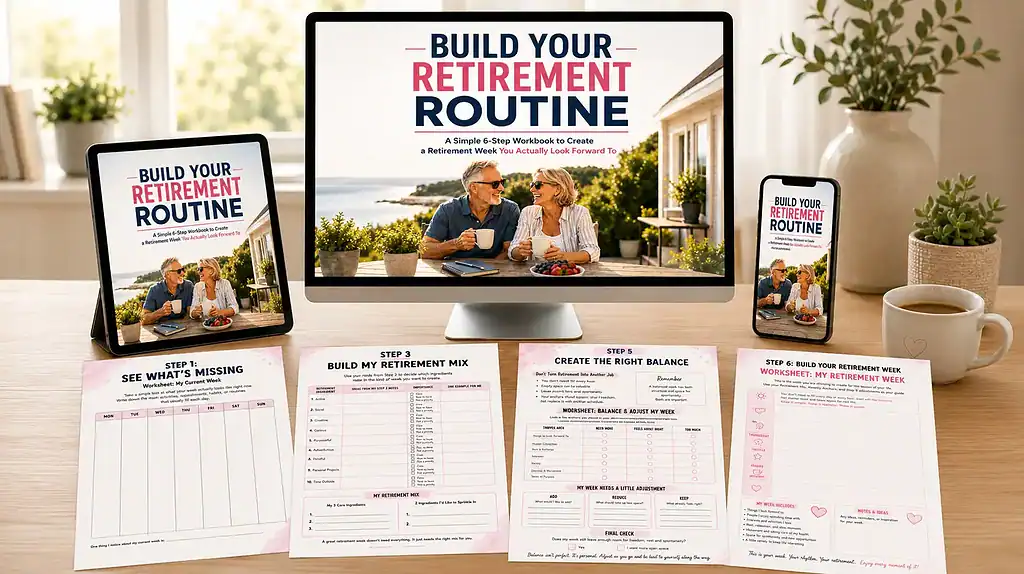
Create a Loose Weekly Rhythm
Freedom is one of the best parts of retirement.
But complete freedom with no structure can eventually become difficult.
Create a few regular anchors in your week and build your retirement routine.
For example:
- Monday: exercise and errands
- Tuesday: hobby or class
- Wednesday: lunch with a friend
- Thursday: volunteering or a personal project
- Friday: something fun together
- Weekend: family, travel, rest, or spontaneity
This is not about recreating your work schedule.
It is about giving your week enough rhythm that the days do not all start blending together.
Your retirement routine will probably change several times before it feels right.
That is normal.
Retirement is not only something you financially prepare for.
It is a new stage of life you gradually learn how to live.
Retirement Is More Than a Financial Plan
Preparing for retirement is about much more than reaching a certain number in your savings account.
You are also preparing for a different rhythm of life.
That means knowing how you will pay the bills, but also thinking about where you will live, who you will spend your time with, what will give your days structure, and what will make this next chapter feel meaningful.
You do not need to have every detail figured out before your last day at work.
Start with these steps to take before retirement, work through them one at a time, and give yourself permission to adjust along the way.
The goal is not to create the perfect retirement.
It is to enter it financially prepared, emotionally ready, and excited about the life ahead.
