
Shadow Work For Beginners: Simple Steps To Start 🌙
I’ve been practicing shadow work for over 15 years, exploring many different strategies along the way. One thing I’ve learned: shadow work isn’t a straight line. It’s not about checking off a box and being “done.” It’s a circular process where you revisit the same themes, each time from a new perspective and deeper level of awareness.
Shadow work is about meeting the parts of yourself you’ve pushed aside — old wounds, hidden fears, or patterns that no longer serve you. When you approach them with kindness and curiosity, they transform. You begin to understand your subconscious mind, soften around negative emotions, and open space for real growth.
Think of it as peeling back layers. With each round, you uncover more self-understanding, more compassion, and more freedom to live authentically. In this guide, I’ll share simple steps and shadow work ideas to help you start your own journey. My hope is that you’ll find the courage to explore your hidden sides and the joy that comes from bringing them into the light.
Shadow Work For Beginners

Light and Shadow in Everyone
Shadow work begins with the simple act of awareness. It’s about recognizing that every person carries both light and shadow — the qualities we show the world and the ones we tend to hide. The shadow often holds things like fears, insecurities, childhood wounds, or emotions we’ve labeled as “bad.” But those hidden parts also hold wisdom, strength, and insight.
The Shadow Is Not Your Enemy
For beginners, the first step is understanding that the shadow is not your enemy. It’s simply a part of your subconscious mind waiting for acknowledgment. When you face your shadow with compassion, you create space for transformation. You may find yourself reacting less to triggers, feeling lighter around old memories, or noticing fresh clarity in your relationships.
Practices That Support Self Discovery
Shadow work is closely tied to self discovery and can be approached through different practices. Some people find healing in writing therapy, where journaling helps them uncover layers of truth. Others connect with shadow work art therapy, using creative expression to process emotions they can’t yet put into words. A work journal is a powerful companion, giving you a safe container to capture your reflections, feelings, and progress.
Embracing Divine Feminine Energy
This practice also aligns beautifully with Divine Feminine Spirituality, which emphasizes gentleness, nurturing, and flow. Instead of forcing yourself to “fix” what’s broken, you’re learning to embrace your whole self. That’s where the real magic of shadow work lies — in accepting both the light and the dark as parts of your authentic being.
How To Start Shadow Work For Beginners
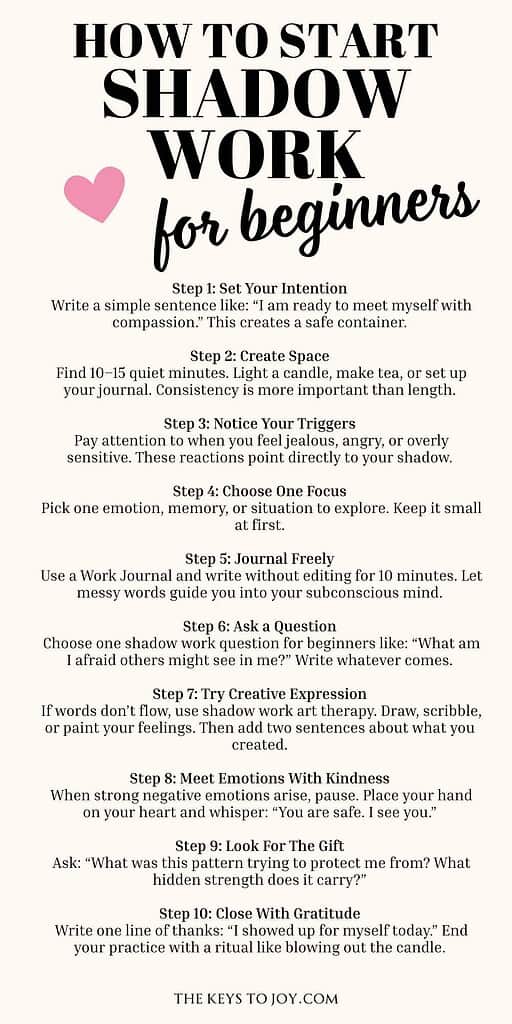
Here’s a gentle, practical, step-by-step path you can follow today. Shadow work is circular, so you’ll revisit themes with new insight. Go slow, stay kind.
1) Set your intention and container
Decide why you’re here. Write one sentence like “I’m ready to meet myself with compassion.” Create a simple container: ten quiet minutes, a candle, and a Work Journal you only use for Shadow Work For Beginners. A clear ritual signals safety to your Subconscious Mind.
Try this: Date your page, write your intention, draw a tiny check box for “I showed up.”
2) Choose a gentle entry point
Start light. Pick a small trigger from this week, not your biggest wound. Name the feeling without judgment. This is Self Discovery in action.
Prompt: “When I felt [emotion], what did I need but didn’t ask for?”
3) Regulate before you explore
Your nervous system sets the tone. Breathe in for four, out for six, for two minutes. Place a hand on your heart to soften Negative Emotions.
Support: A rose quartz palm stone or lavender roller can anchor calm.
4) Free-write for ten minutes
Practice Writing therapy. Set a timer and write without editing. Let messy words lead you. This is where how to start shadow work for beginners becomes real.
Prompt: “If my shadow could speak today, it would say…”
5) Ask one powerful question
Keep it simple. One question keeps the mind focused and kind. Think Shadow Work Questions not interrogations.
Try one: “What am I protecting by staying the same?” or “What do I fear people might see in me?”
6) Dialogue with a part of you
Write as “Me” and “Younger Me.” Offer curiosity, not fixes. This builds trust with your Subconscious Mind.
Script starter:
Me: “I’m listening. What feels hard?”
Younger Me: “I’m scared of being ignored.”
Me: “Thank you for telling me. I won’t leave you.”
7) Create, then translate
Do five minutes of Shadow Work Art Therapy. Scribble anger, watercolor sadness, collage safety. Then write two sentences about what you made. Creative play unlocks new shadow work ideas.
Support: Soft watercolor set and thick paper pad make this inviting.
8) Reframe with compassion
Name the protective role of a pattern. Appreciation softens shame.
Prompt: “This pattern once kept me safe by…”
Then: “Today, I choose a kinder strategy like…”
9) Close with a micro-ritual
End cleanly. Place your hand on your heart. Whisper, “Thank you for trying.” Note one tiny action you’ll take before tomorrow. Honor Divine Feminine Spirituality with softness, warmth, and flow.
Support: Undated wellness planner to log tiny wins.
10) Review weekly and loop
On Sundays, reread the week. Circle words that repeat. That’s your next doorway into how to do shadow work for beginners. You are looping back, not falling behind.
Prompt: “What theme keeps returning, and what new need does it reveal?”
Optional tools that make practice joyful
- Beautiful guided journal for shadow work journal prompts beginners
- Timer cube for effortless ten-minute sessions
- Oracle card deck to spark shadow work questions for beginners
Quick starter checklist
- Intention written
- Two minutes of breath
- One prompt answered
- One line of compassion noted
- One tiny next step chosen
How To Do Shadow Work For Beginners
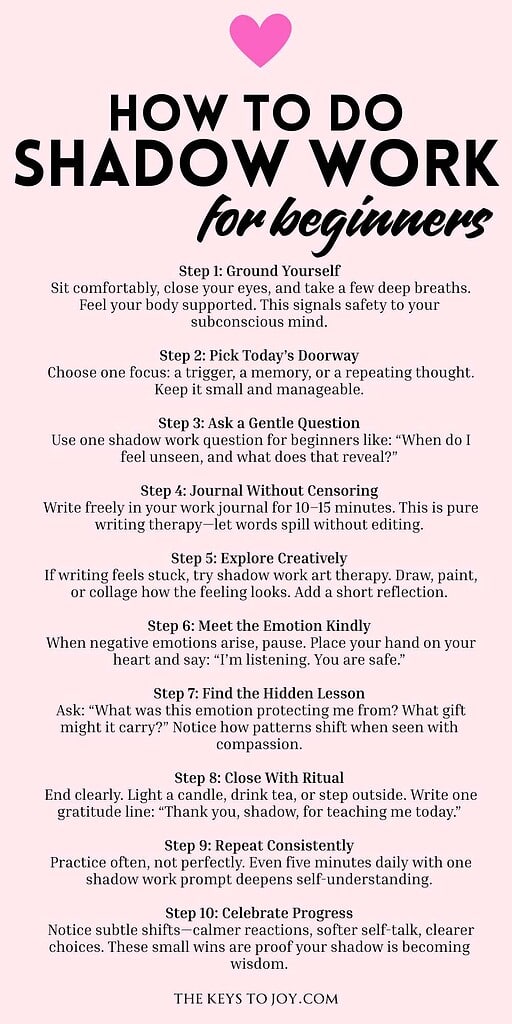
Shadow work is not about fixing yourself. It’s about sitting with your whole self — light and shadow — with compassion. Here’s a clear way to practice regularly:
1) Ground yourself before you begin
Sit comfortably. Breathe in for four counts, out for six. Feel your body supported by the chair or floor. This grounds your energy so your subconscious mind feels safe to open.
2) Identify today’s doorway
Pick one focus for your session. Maybe it’s a trigger, a recurring dream, or a memory that popped up. Keep it specific and small. Shadow work is circular — you’ll revisit themes over time.
3) Ask a guiding question
Choose one shadow work question for beginners to explore. For example:
- “What am I most afraid people will find out about me?”
- “When do I feel unseen, and what does that reveal?”
- “What memory still feels heavy when I recall it?”
Write the question at the top of your work journal page.
4) Let writing lead the way
Practice writing therapy by free-writing for 10–15 minutes. Don’t censor yourself. Let words tumble out, even if they don’t make sense. This practice connects you directly with your self discovery process.
5) Explore with creativity
If words feel stuck, switch to shadow work art therapy. Scribble anger, paint longing, or collage hidden dreams. Then add a few lines of reflection beneath your creation. Art bypasses the thinking mind and taps straight into the shadow.
6) Meet the emotion with compassion
When strong negative emotions arise, pause and soften. Place your hand on your heart. Whisper: “You are safe. You are seen.” Imagine you are holding space for your younger self. This is where healing begins.
7) Look for the hidden gift
Every shadow carries a message. Ask: What was this emotion trying to protect me from? What gift is buried inside this wound? For example, anger may reveal your need for respect. Fear may point to your desire for safety and connection.
8) Close with integration
Don’t leave yourself open-ended. Close the session with a simple ritual: light a candle, sip tea, or step outside for fresh air. Write one line of gratitude in your journal, even if it’s small: “I showed up for myself today.”
9) Repeat consistently, not perfectly
Doing shadow work isn’t about depth every time. Some days will feel light, others intense. The key is consistency. Ten minutes with one shadow work prompt is enough to slowly build trust with yourself.
10) Celebrate your progress
Shadow work is deep, but it can also feel joyful. Notice how you respond differently in daily life, how relationships soften, how old stories lose their grip. Celebrate those shifts. They’re proof that your shadow is turning into wisdom.
Shadow Work Questions For Beginners

Asking the right questions is at the heart of shadow work. These questions guide you into your subconscious mind, helping you uncover patterns, soften negative emotions, and move toward real self discovery. Pick just one at a time. Let the answers flow into your work journal without judgment.
1) What emotions do I avoid feeling, and why?
2) When do I feel most triggered, and what does it remind me of?
3) What part of myself do I try to hide from others?
4) Which traits in others annoy me — and how do they reflect my own shadow?
5) When have I betrayed my own needs to please someone else?
6) What do I fear people would think if they truly knew me?
7) Which childhood memory still feels unfinished or painful?
8) What limiting beliefs about myself keep repeating in my life?
9) When do I feel jealous, and what does that reveal about my desires?
10) In what ways do I self-sabotage, and what am I protecting by doing so?
11) What does my inner critic say most often, and where did that voice come from?
12) When have I felt unworthy of love or success, and why?
13) What relationships bring out my shadow side most strongly?
14) What am I afraid to admit, even to myself?
15) If I met my younger self, what would they ask me to heal?
Use these shadow work questions for beginners one at a time. Write freely, pause when needed, and let curiosity guide you instead of pressure. Over time, you’ll see how even small reflections open up big shifts in awareness.
Shadow Work Journal Prompts Beginners

Journaling is one of the most approachable ways to begin shadow work. It combines writing therapy with self discovery, giving your subconscious mind space to speak. These shadow work journal prompts beginners can use are gentle but powerful. Choose one at a time and write freely — no editing, no judgment.
1) Write about a recent moment when you felt jealous. What hidden need or desire does it reveal?
2) Describe a time you felt dismissed as a child. How does that memory shape your reactions today?
3) Write a letter to the part of you that feels unworthy of love or success. What do you want it to know?
4) Think of a person who triggers you. Journal about what part of yourself they mirror back to you.
5) Write about a belief you hold that feels heavy. Where did it come from, and is it still true?
6) Journal about the last time you avoided conflict. What fear guided that choice?
7) Write a dialogue between your present self and your younger self. Let your younger self speak first.
8) Explore a “negative” trait you try to hide. How might that trait also be a gift?
9) Write about a time you felt abandoned. What do you wish someone had said or done for you?
10) Imagine your shadow as a character. Describe what it looks like, feels like, and wants from you.
These shadow work ideas are designed to meet you where you are. Some days, you might write a page. Other days, you might write a single sentence. Both are perfect. What matters is showing up with curiosity and compassion.
Shadow Healing Prompts
Healing through shadow work is about meeting yourself with love. These prompts invite you to soften around negative emotions, listen to your subconscious mind, and find the hidden wisdom in your pain. Use them in a work journal, or explore through writing therapy or even shadow work art therapy if words feel heavy.
1) Write a compassionate letter to a younger version of yourself who felt unseen. Tell them what you wish they had heard.
2) Journal about a painful memory. Then write down three strengths it gave you that you now carry.
3) Imagine sitting across from your shadow. Ask it what it needs from you right now. Write its reply.
4) Write about a part of yourself you’ve judged harshly. How can you reframe it as a protector or teacher?
5) Recall the last time you felt abandoned. Journal about how you can give yourself the love you craved in that moment.
6) Write down one fear you’ve carried for years. Then explore: what would happen if I met this fear with kindness?
7) Imagine your shadow holding a gift for you. What does it hand you, and how does it change your story?
8) Write a forgiveness letter — not to someone else, but to yourself.
9) Journal about the ways your shadow has shaped your resilience. Celebrate one hidden strength it gave you.
10) End with gratitude: list three ways your shadow has helped you grow into who you are today.
These shadow healing prompts remind you that shadow work isn’t about fixing what’s broken. It’s about embracing every part of yourself — the light and the dark — as pieces of your wholeness. Healing happens in small, gentle steps, and every time you show up, you’re rewriting your story with compassion.
Healing with Compassen
Shadow work isn’t a race—it’s a loving return to yourself. Some days you’ll write one honest sentence. Other days you’ll feel a big release. Both count. Keep showing up with softness and curiosity, and watch how life gets lighter and more true.
Want more gentle support? Explore these reads on TheKeysToJoy:
- 100+ Shadow Work Questions To Transform Your Life 💫
- Gratitude Journal Ideas You Haven’t Tried (But Should!)
- Inner Child Healing Secrets That Will Set You Free!
Save this pin now so you’ll always have these beginner steps at your fingertips 🌙
