
Best Strength Training Exercises For Women Over 50
Some links in this post are affiliate links. As an Amazon Associate, we earn from qualifying purchases that help keep our content free.
Strength training after 50 can help you maintain muscle, protect your independence, improve balance, and make everyday life feel easier. And you do not need complicated gym workouts to benefit. The best strength training exercises for women over 50 are simple movements that train your legs, hips, back, chest, shoulders, arms, and core.
In this guide, you’ll learn which exercises matter most, how to adapt them to your fitness level, how often to train, and how to build a routine that helps you become stronger without pushing your body harder than it needs.
The Best Strength Training Exercises
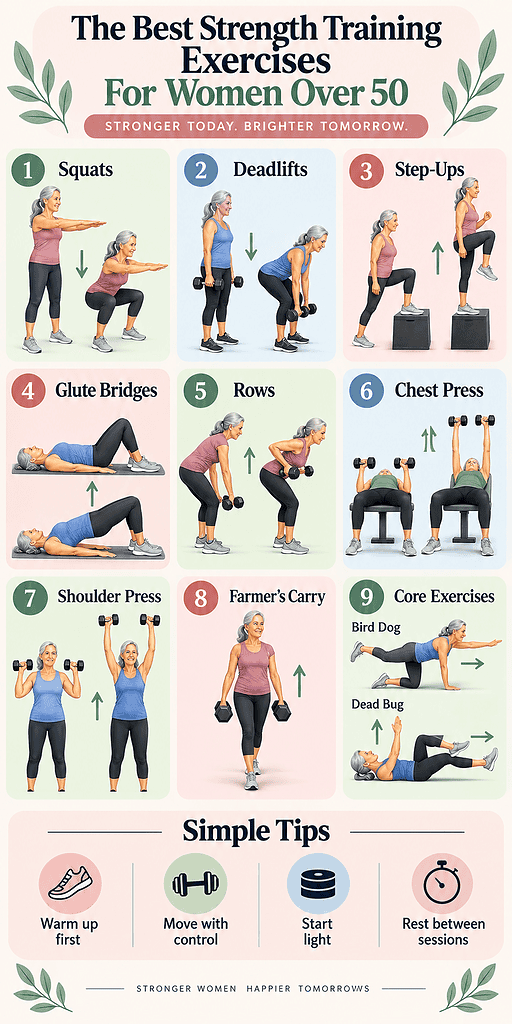
The best strength training exercises for women over 50 are the ones that train multiple muscle groups, improve everyday movement, and can be adjusted to your current fitness level.
You do not need dozens of exercises.
A small group of well-chosen movements can train your whole body effectively.
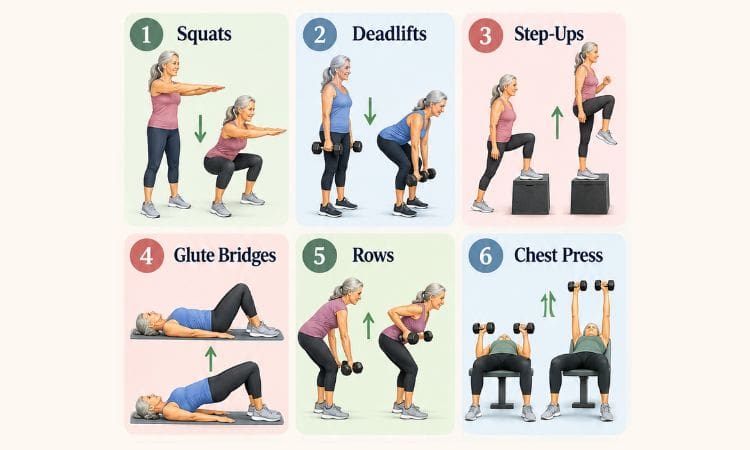
1. Squats
Squats strengthen your thighs, glutes, hips, and core.
They also mimic something you do every day: sitting down and standing back up.
Start with:
- chair squats
- bodyweight squats
- goblet squats holding one dumbbell
Keep your feet comfortable, sit your hips back, and only go as low as feels controlled.
2. Deadlifts
Deadlifts strengthen your glutes, hamstrings, back, and core.
They also teach you how to safely pick things up from the floor.
For beginners, a dumbbell Romanian deadlift is often a simple place to start.
Focus on pushing your hips back rather than turning the movement into a squat.
3. Step-Ups
Step-ups are excellent for leg strength, balance, and everyday function.
Use a low step at first.
Step up with control, stand tall, and lower yourself slowly.
You can hold onto something for support or add dumbbells when the exercise becomes easier.
4. Glute Bridges
Glute bridges strengthen the muscles around your hips and backside.
Lie on your back with your knees bent, press through your feet, and lift your hips.
This is especially useful if you are new to strength training or not yet comfortable doing heavier lower-body exercises.
5. Rows
Rows strengthen your upper back and arms.
They are a great counterbalance to all the sitting, driving, and screen time most of us do.
You can use:
- dumbbells
- resistance bands
- cable machines
Pull your elbows back while keeping your shoulders relaxed.
6. Chest Press
A chest press strengthens your chest, shoulders, and triceps.
You can do it with dumbbells on a bench or floor, or use a chest press machine.
Wall push-ups and elevated push-ups are also good beginner alternatives.
7. Shoulder Press
Shoulder presses build strength in your shoulders and upper arms.
This can make everyday activities like lifting something onto a shelf much easier.
Start light and move slowly.
If pressing overhead feels uncomfortable, choose another shoulder exercise rather than pushing through pain.
8. Farmer’s Carry
This simple exercise is incredibly practical.
Hold a weight in each hand and walk slowly while standing tall.
It trains:
- grip strength
- shoulders
- core
- legs
- posture
It also prepares you for real-life tasks like carrying groceries or luggage.
9. Core Exercises
You do not need hundreds of crunches.
Some of the best ab exercises for women over 50 are movements that teach your core to stabilize your body.
Try:
- bird dogs
- dead bugs
- planks
- side planks
- farmer’s carries
These exercises train your core while also supporting balance and everyday movement.
The best exercise for women over 50 is not about isolating one body part.
A strong routine trains your whole body and helps you move with more confidence in daily life.
A Safe Beginner Strength Routine
If you are new to strength training, keep your first routine simple.
Try this 2 times per week, leaving at least a day of recovery between sessions:
- Chair squat: 8–10 reps
- Glute bridge: 10–12 reps
- Supported dumbbell or band row: 8–10 reps
- Wall push-up: 8–10 reps
- Low step-up: 6–8 reps per leg
- Farmer’s carry: 20–30 seconds
- Bird dog: 6–8 reps per side
Start with 1 set of each exercise. When that begins to feel comfortable and your form stays controlled, build toward 2 sets.
Choose a resistance that feels challenging near the end but still allows you to move with good technique.
A few simple rules:
- warm up with 5–10 minutes of easy walking or movement
- move slowly and with control
- breathe normally rather than holding your breath
- stop if you feel sharp pain, dizziness, or unusual shortness of breath
- increase weight gradually instead of rushing
If you have osteoporosis, significant joint problems, heart disease, a recent injury, or another medical condition that affects exercise, ask your healthcare professional or a qualified trainer about appropriate modifications before starting.
Your first goal is not to lift heavy.
It is to learn the movements, build confidence, and create a routine you can safely progress over time.
Why Strength Training Matters After 50
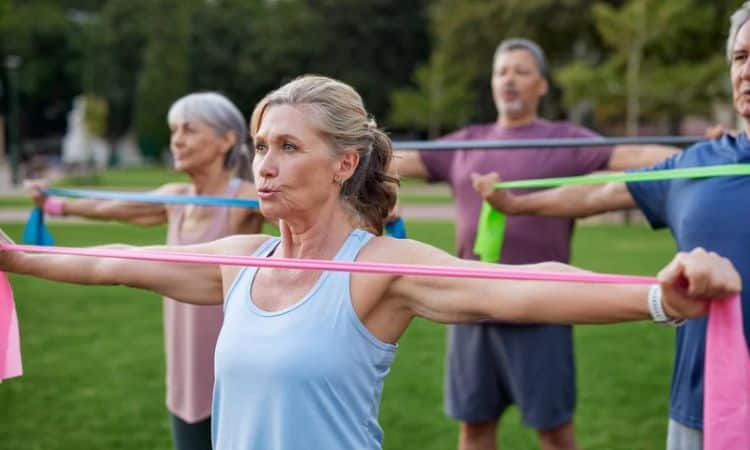
Strength training becomes more important after 50 because your body naturally starts to lose muscle and bone strength as you age. Menopause can add another layer, because lower estrogen levels are linked with faster bone loss.
The good news is that strength training can help you stay strong, steady, and independent.
Muscle Loss After 50
Losing muscle is not only about appearance.
Less muscle can make everyday things harder, such as:
- climbing stairs
- carrying groceries
- getting up from a chair
- lifting luggage
- keeping your balance
- staying active as you get older
That is why the best strength training for women focuses on the whole body, not just one area.
Your legs, hips, back, chest, shoulders, arms, and core all need attention. Current U.S. guidelines recommend muscle-strengthening activities at least 2 days per week that work all major muscle groups.
And you do not need years of gym experience to start.
A simple weights workout for women beginner routine can use dumbbells, resistance bands, machines, or even your own body weight.
Bones, Balance, and Everyday Strength
After menopause, bone health becomes especially important because declining estrogen can accelerate bone loss and increase the risk of osteoporosis.
Strength training can also support balance and make the muscles around your joints stronger.
Think beyond how your body looks.
Being able to:
- get off the floor easily
- carry heavy shopping bags
- walk up stairs without struggling
- move furniture
- travel confidently
- stay active with family
is real strength.
This is also why transforming your body after 50 should not be only about losing weight.
A stronger body may weigh the same, or sometimes even more, while functioning far better.
And for many women, that is the most valuable transformation of all.
How Heavy Should You Lift?
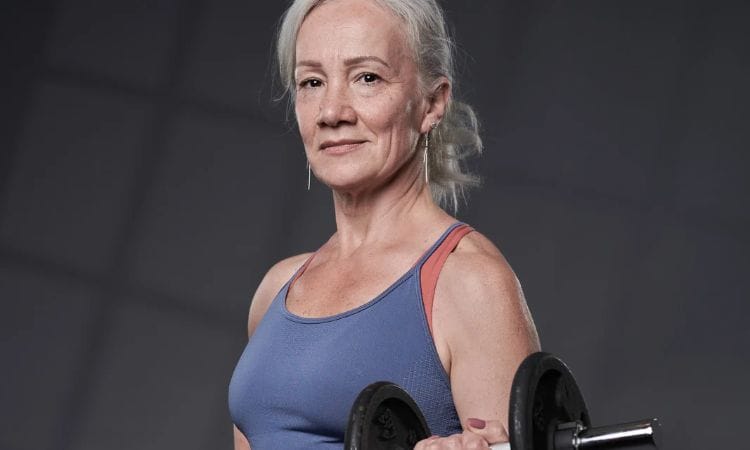
You do not need to lift extremely heavy weights to get stronger.
But the weight should be challenging enough that your muscles have to work.
A useful rule is this:
The last few repetitions should feel difficult, but your form should still stay controlled.
If you finish 12 repetitions and feel like you could easily do 10 more, the weight is probably too light.
Reps and Sets
For most beginners, a simple starting point is:
- 8–12 repetitions per exercise
- 1–2 sets
- 2 strength workouts per week
- rest about 1–2 minutes between sets
You do not have to train until complete exhaustion.
The goal is challenge, not punishment.
Beginner Weight-Selection Guide
If you are completely new, start lighter than you think you need to.
For the first set, choose a weight that feels comfortable and focus on learning the movement.
Then ask yourself:
- Could I do 10 more reps easily? Go a little heavier.
- Could I do 3–4 more reps? You are probably close to the right weight.
- Could I barely finish the set? The weight may be too heavy for a beginner.
- Did your form start to break down? Reduce the weight.
A rough starting point might be:
- Upper-body exercises: 3–8 lb dumbbells
- Lower-body exercises: 5–15 lb dumbbells
- Farmer’s carries: a weight you can carry with good posture for 20–30 seconds
These are only starting examples, not rules. One woman may need much less, another much more.
Your body should decide the weight, not the number printed on the dumbbell.
When to Increase the Weight
Your body adapts.
That means the same weight that feels difficult today may feel easy several weeks from now.
When you can comfortably complete all your repetitions with good form, you can gradually:
- add a little more weight
- add a few repetitions
- add another set
- make the exercise slightly more difficult
For example, if you can do 12 goblet squats comfortably with a 10-pound dumbbell, try moving up slightly next time.
You should feel challenged.
You should not feel pain.
And remember: “heavy” is personal.
The right weight is simply one that makes your muscles work while allowing you to maintain good form.
How Often Should Women Over 50 Strength Train?
For most women over 50, 2–3 strength workouts per week is a great target.
You do not need to lift weights every day.
Your muscles actually get stronger during the recovery period after training, so rest matters too.
A simple schedule could look like:
- Monday: Full-body strength workout
- Tuesday: Walking or light cardio
- Wednesday: Rest or mobility
- Thursday: Full-body strength workout
- Friday: Walking or cardio
- Weekend: Rest, walking, or another activity you enjoy
If you already have more experience, you might strength train three or four times per week and split your workouts between different muscle groups.
How Long Should a Workout Be?
A strength workout does not need to take an hour.
For beginners, 20–40 minutes can be enough to train your major muscle groups.
Quality matters more than length.
Six or seven well-chosen exercises performed with good form can be more useful than doing dozens of random exercises.
Give Your Muscles Time to Recover
Try to avoid training the same muscles hard on consecutive days.
Around 48 hours between full-body strength workouts gives your muscles time to recover.
Recovery also depends on:
- sleep
- nutrition
- protein intake
- stress
- workout intensity
- your current fitness level
If you still feel unusually sore or exhausted when your next workout arrives, give yourself another recovery day.
Your training schedule should challenge you, but it should also leave enough energy for the rest of your life.
Consistency over months and years matters far more than squeezing in as many workouts as possible each week.
A Simple Full-Body Strength Workout
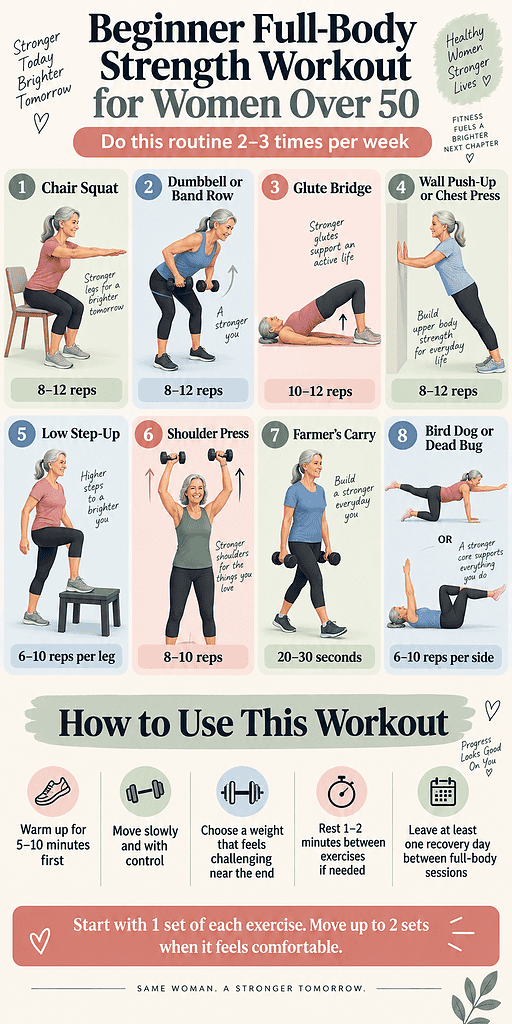
You do not need a complicated plan to get stronger.
A simple full-body routine done 2–3 times per week can work very well.
Try this:
Beginner Full-Body Workout
- Chair Squat
8–12 reps - Dumbbell or Band Row
8–12 reps - Glute Bridge
10–12 reps - Wall Push-Up or Chest Press
8–12 reps - Low Step-Up
6–10 reps per leg - Shoulder Press
8–10 reps - Farmer’s Carry
20–30 seconds - Bird Dog or Dead Bug
6–10 reps per side
Start with 1 set of each exercise.
Once that feels comfortable, move up to 2 sets.
How to Use This Workout
Keep it simple:
- warm up for 5–10 minutes first
- move slowly and with control
- choose a weight that feels challenging near the end
- rest 1–2 minutes between exercises if needed
- leave at least one recovery day between full-body sessions
If an exercise causes pain, stop and choose a more comfortable variation.
The goal is not to finish as fast as possible.
The goal is to perform each movement well and gradually get stronger over time.
How to Progress
After a few weeks, you can make the workout harder by:
- increasing the weight
- adding a few reps
- adding another set
- using a harder exercise variation
- slowing down the movement
You do not need to change everything at once.
Small increases are enough.
This type of routine gives you the foundation of the best strength training for women: simple movements, full-body training, gradual progression, and enough recovery to keep doing it consistently.
If You Are Completely New to Strength Training
Starting strength training after 50 can feel intimidating, especially if you have never used weights before.
The most important thing is to start at your current level.
You do not need to lift heavy. You do not need perfect form on day one. And you do not need a complicated gym routine.
Start with:
- 1–2 short sessions per week
- simple full-body exercises
- light weights or resistance bands
- slow, controlled movements
- enough recovery between sessions
If needed, begin with chair squats, wall push-ups, glute bridges, supported rows, and light carries.
Once those movements feel comfortable, you can gradually add more resistance.
A beginner weights workout for women should feel manageable enough that you want to come back and do it again.
If you have osteoporosis, significant joint problems, heart disease, a recent injury, or another condition that affects exercise, ask your healthcare professional about appropriate modifications before starting.
Common Strength Training Mistakes After 50
Strength training does not need to be complicated, but a few common mistakes can slow your progress.
1. Using Weights That Are Always Too Light
Starting light is smart.
Staying with the same very light weights forever is not.
Your muscles need gradually increasing resistance to keep adapting.
2. Doing Too Much Too Soon
More is not always better.
Jumping straight into hard workouts five days a week can leave you exhausted, sore, and more likely to quit.
Build gradually.
3. Training Only Your Arms or Abs
It is understandable to search for things like how to tighten arms fast or the best ab exercises for women over 50.
But you cannot build a strong body by focusing on only one area.
Your legs, hips, back, chest, shoulders, arms, and core all matter.
4. Ignoring Recovery
Your muscles need time to repair after training.
Sleep, protein, hydration, and rest days are part of your workout plan too.
5. Chasing Soreness
You do not need to feel sore after every workout for it to be effective.
Progress is a better measure than soreness.
Are you lifting a little more?
Doing more reps?
Moving with better control?
Feeling stronger in daily life?
Those are the signs that matter.
Getting Stronger Is the Goal
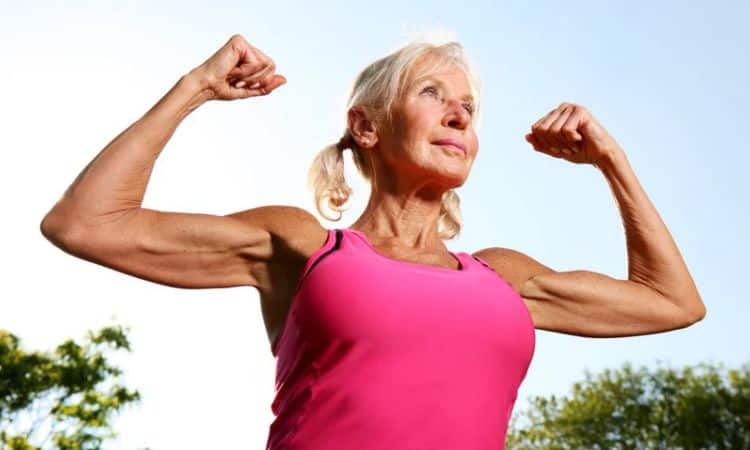
Strength training after 50 is not about trying to look 25 again.
It is about building a body that supports the life you want to keep living.
A stronger body can help you carry groceries, climb stairs, travel, garden, play with grandchildren, get up from the floor, and stay independent as you age.
That is why the best strength training for women is not the most extreme program.
It is the one you can do consistently and gradually progress.
If you are transforming your body after 50, strength is one of the best places to start.
Choose a few simple exercises.
Learn them well.
Add resistance slowly.
Give your body time to recover.
Then keep going.
The goal is not perfection.
The goal is to be a little stronger than you were before.
